When your personal Futures Cooperate
Most people believe their problem is indecision. They revisit the same choice repeatedly, collect more information than they need, and still feel unable to move. It looks like uncertainty, lack of discipline, or fear of commitment. But very often the real issue is structural: the decision is not being made by one person, but by several legitimate versions of you at the same time — each optimizing for a different future.
One part of you wants growth and realization. Another wants stability and safety. A third wants understanding and depth. A fourth wants relationships and presence. None of them is wrong. Each protects something that matters. The tension does not come from weakness but from simultaneous authority. Without rules, these futures compete in the same space, and the mind experiences it as noise.
Stakeholder mapping is normally used in projects to understand who influences an outcome. Applied personally, it serves a different purpose: it clarifies who has the right to decide. The goal is not self-knowledge in a psychological sense but a constitution of decision-making.
Step 1 — Identify actors, not traits
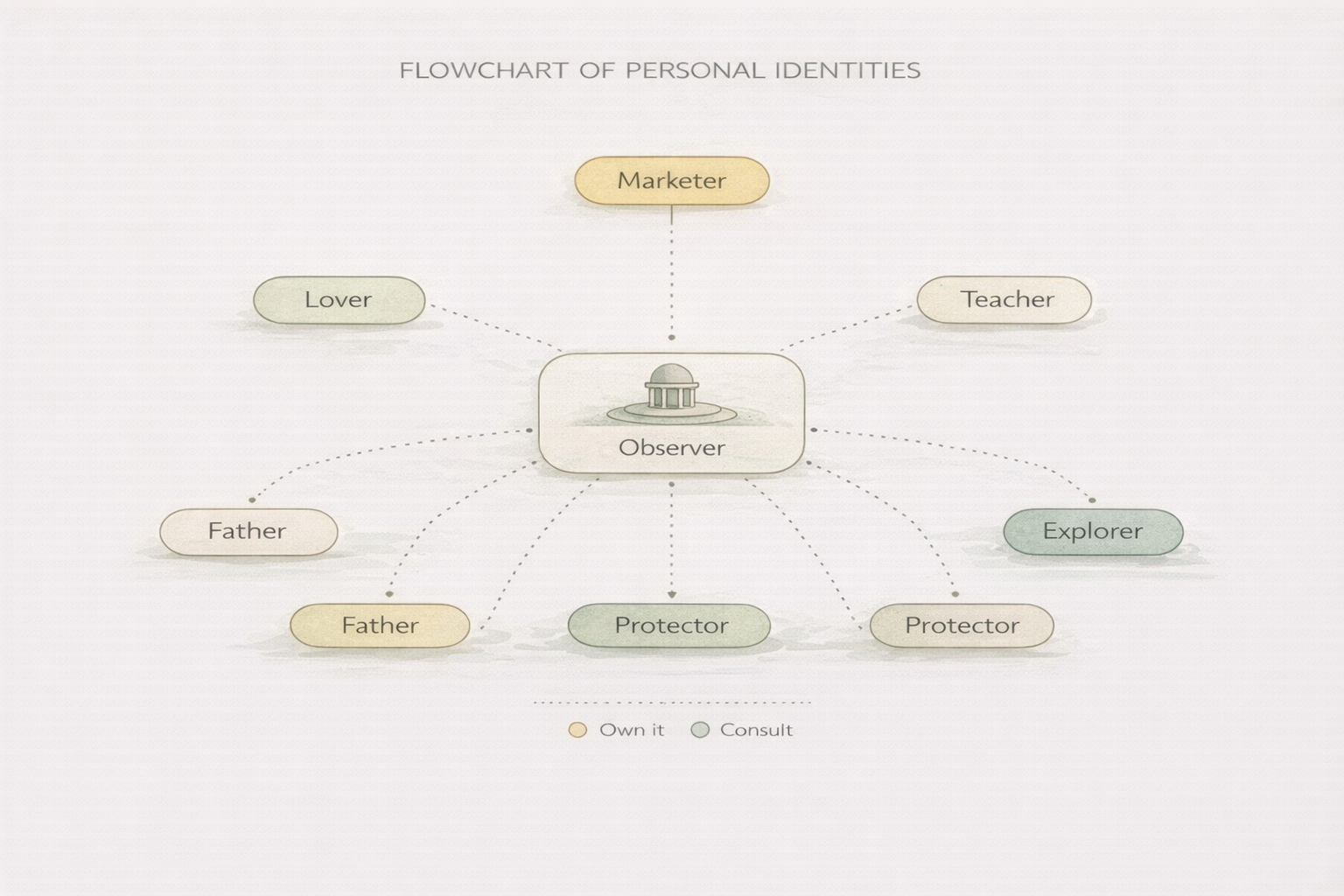
Begin by listing roles that hold legitimate interests in your life. Do not describe personality traits. Describe positions that could sit at a table and defend a direction of the future.
Typically you will find someone who builds and wants impact in the world, someone who seeks understanding and refuses superficiality, someone who shares and teaches, someone who protects security, someone who searches for experience, and someone who protects relationships or closeness. Do not eliminate any of them. Conflict does not arise from their existence but from their simultaneous control.
Step 2 — Define what each protects
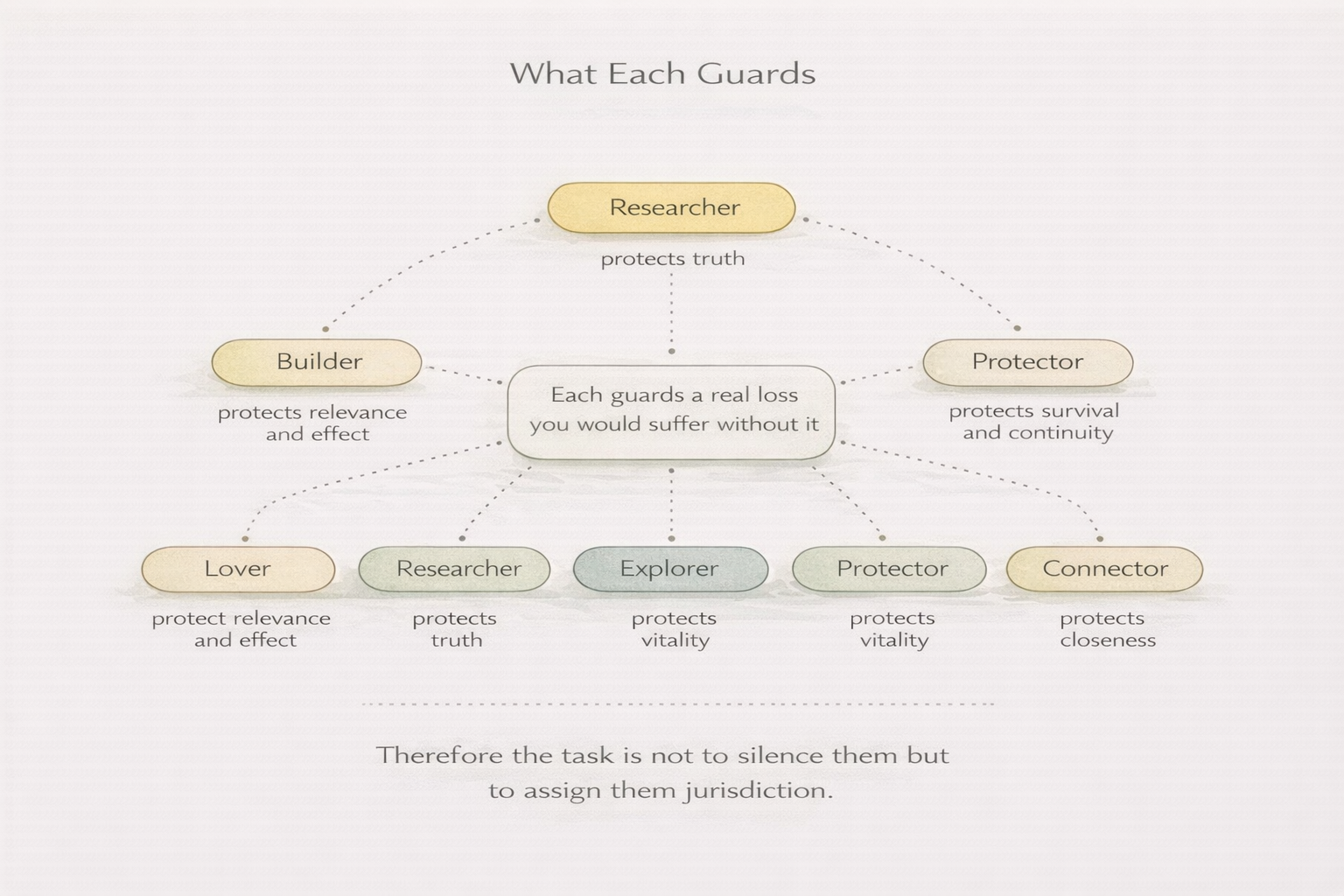
For each actor, write what it is trying to preserve. The builder protects relevance and effect. The researcher protects truth. The cautious part protects survival and continuity. The adventurous part protects vitality. The relational part protects closeness.
At this moment something important becomes clear: none of the voices is irrational. Each guards a real loss you would suffer without it. Therefore the task is not to silence them but to assign them jurisdiction.
Step 3 — Map authority
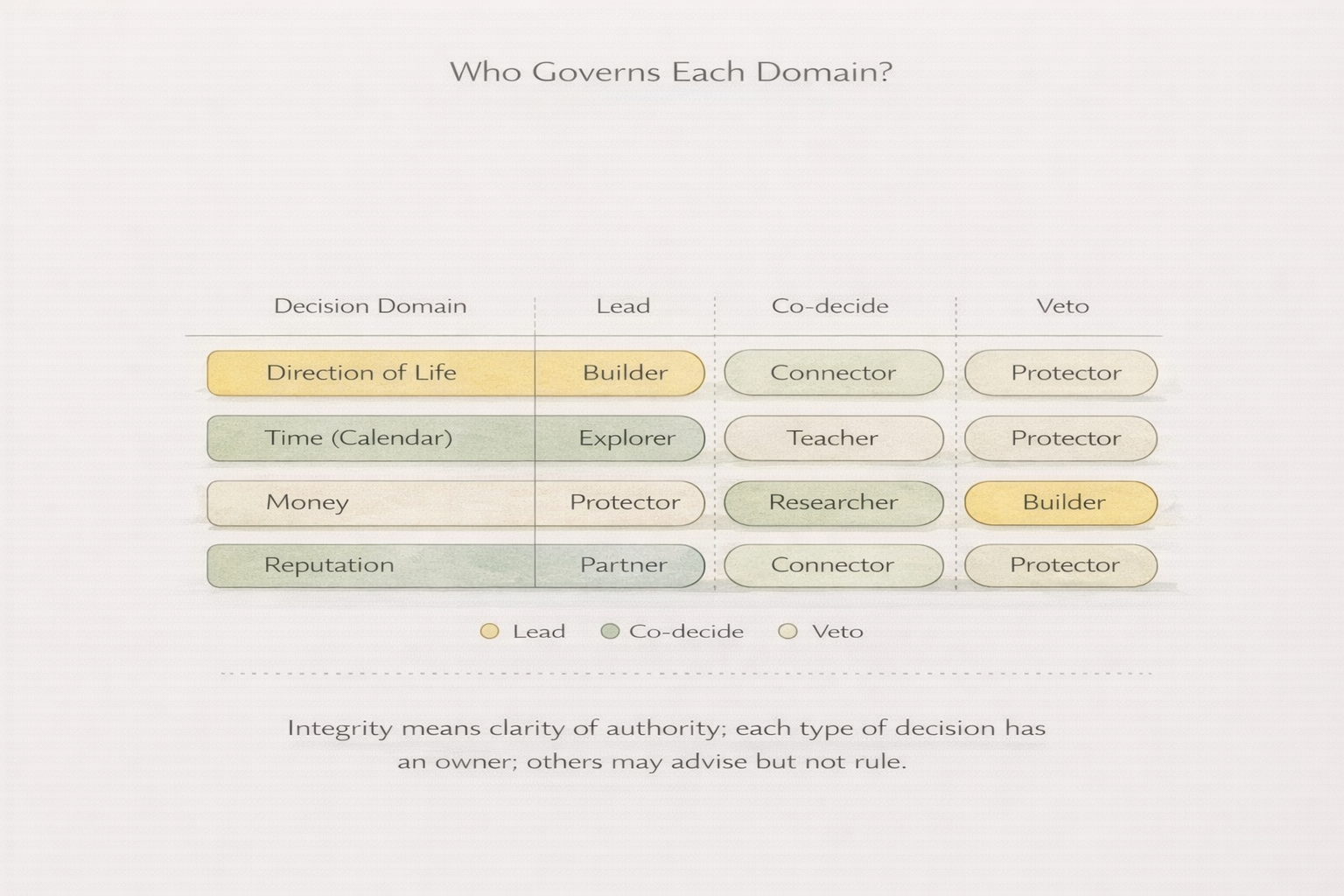
Divide decisions into domains such as direction of life, time (calendar), money, and reputation. For each domain, decide who leads, who co-decides, and who has veto power.
This step usually reveals the source of overwhelm. Many people allow five different futures to govern the same calendar. One accepts opportunities, another searches for meaning, another avoids disappointing others, and another needs uninterrupted depth. The result is not balance but exhaustion.
Integrity here does not mean consistency of personality. It means clarity of authority. Each type of decision has an owner; others may advise but not rule.
Step 4 — Map conflicts
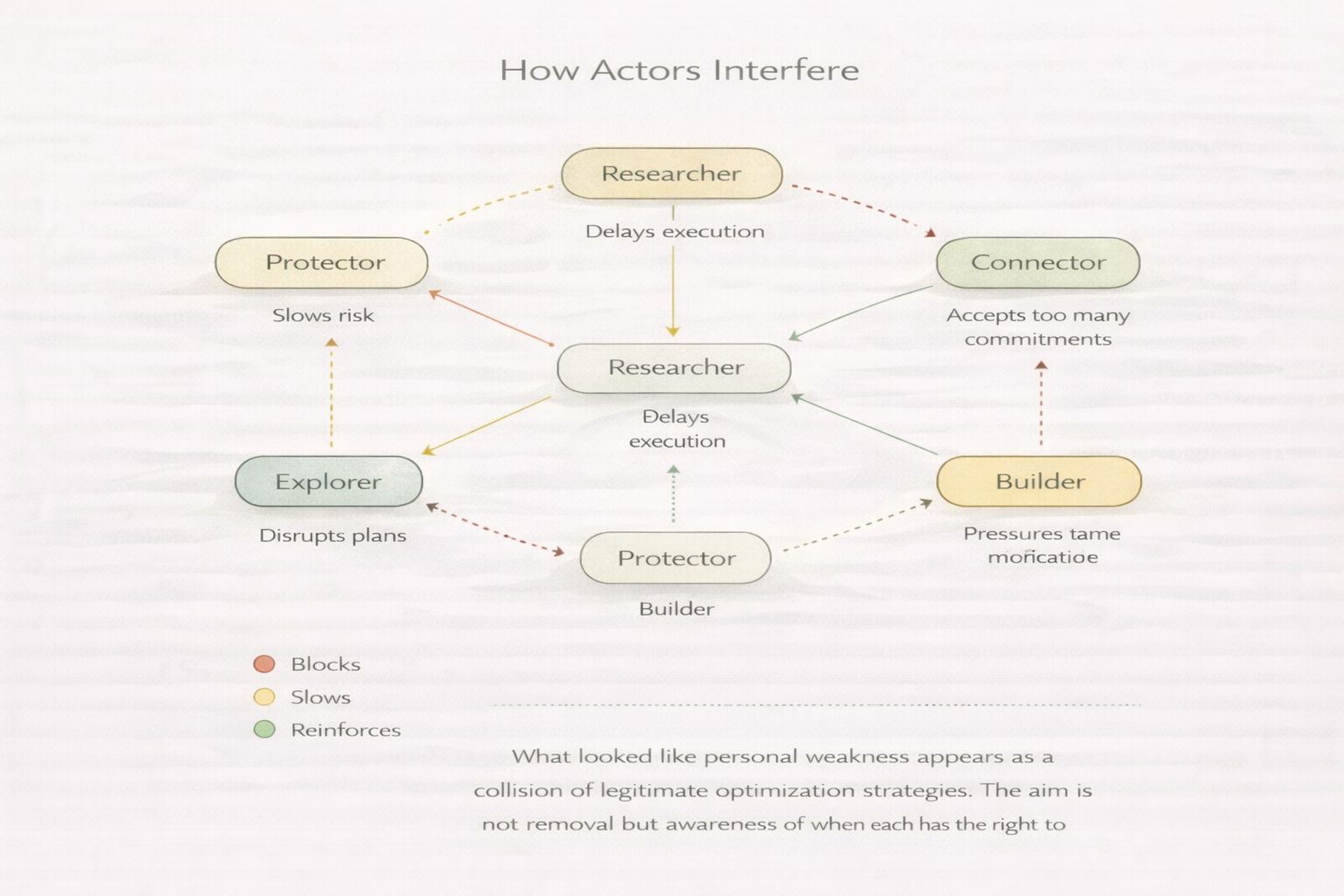
Now draw relationships between actors. Notice who naturally blocks whom. The security-seeking part slows risk. The research-seeking part delays execution. The building part pressures simplification. The experiential part disrupts plans. The sharing part accepts too many commitments.
This stage is often relieving. What looked like personal weakness appears as a collision of legitimate optimization strategies. The aim is not removal but awareness of when each has the right to intervene.
Step 5 — Turn decisions into procedure
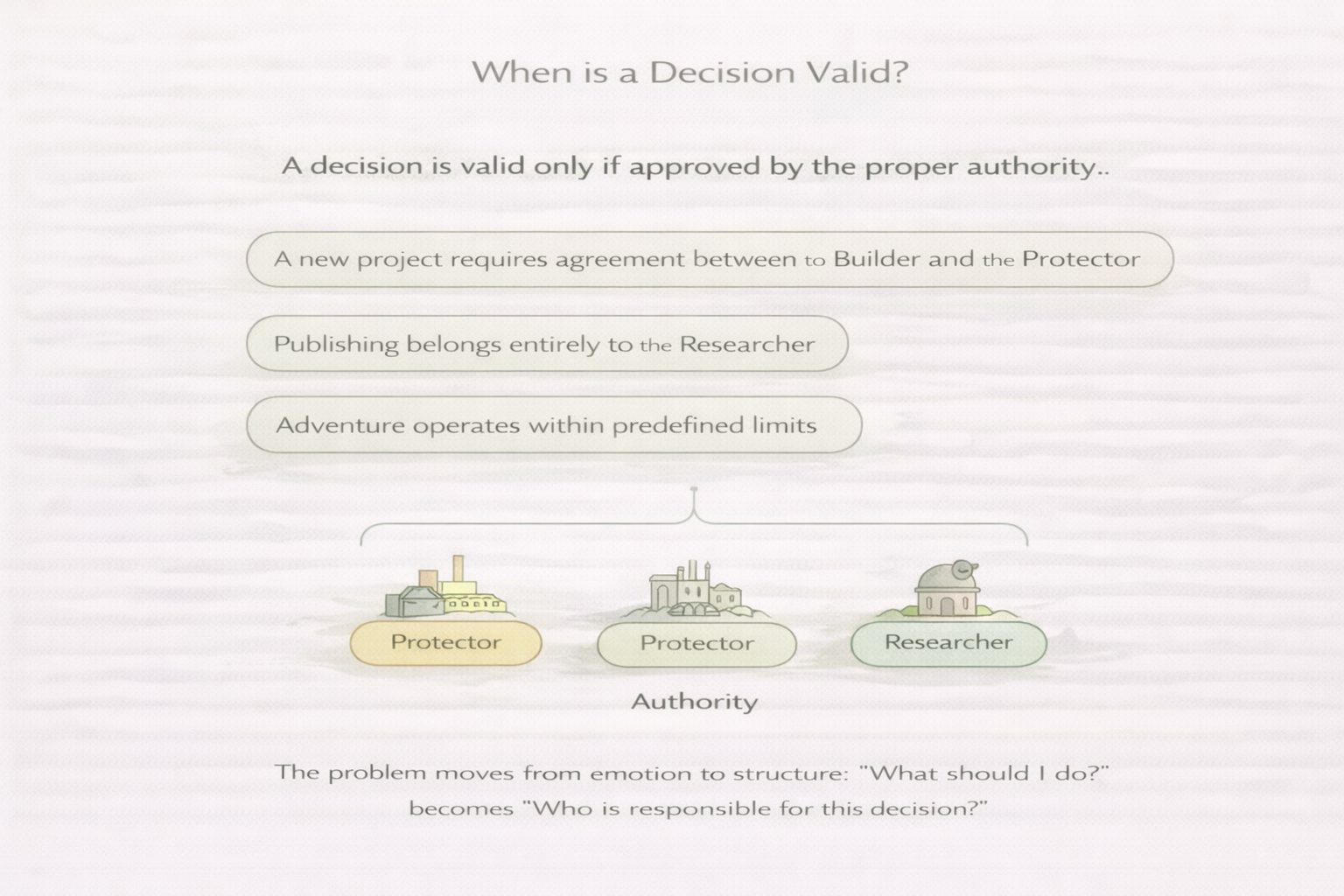
Create a simple rule: a decision is valid only if approved by the proper authority. A new project might require agreement between the builder and the protector of stability. Publishing might belong entirely to the truth-seeking part. Adventure might operate within its own predefined limits.
From that point, the question shifts from “What should I do?” to “Who is responsible for this decision?” The problem moves from emotion to structure.
What changes
Mental noise rarely comes from lack of information or discipline. It comes from overlapping jurisdictions. Once each future has a defined mandate, decisions do not necessarily become easier, but they become quieter.
You are not choosing between identities. You are coordinating legitimate futures so they stop competing and start cooperating.
practical example: accepting a new collaboration
Imagine you receive an offer to join a new project. The partner is interesting, the topic is close to your interests, and the pay is reasonable — but it will take significant time and pull you away from what you are currently building.
Instead of asking “Should I do it?”, you shift to the structural question:
What kind of decision is this, and who has the authority to decide?
Very quickly you see that this is not one decision but several overlapping ones. It affects the direction of your life, your calendar, your reputation, and your income. Each of those domains belongs to a different internal authority.
You might define them roughly like this:
Direction — led by the builder or strategist, with the researcher holding veto power
Time — governed by the protector of capacity, with family or relational commitments holding veto power
Reputation — evaluated by the teacher or researcher
Money — evaluated by the protector of stability
Now the decision becomes a process rather than a feeling.
The builder argues that the project expands impact and opens new territory. The researcher hesitates because it drifts away from the main focus. The protector looks at the calendar and sees overload. The relational role notices that evenings would disappear — and activates a veto.
At this point the outcome is no longer a simple yes or no. The structure produces a condition:
The project can exist only if it fits inside a clearly defined time boundary and replaces something else.
You return to the partner with a constraint rather than an emotion: one dedicated day per week, otherwise the answer is no. If that condition cannot be met, the decision resolves automatically — without guilt and without rumination.
Nothing magical happened. You did not discover your true desire. You clarified authority.
The question quietly changed from “What should I do?” to
“Who is responsible for this decision?”
And with that shift, the problem moved from psychology to structure — from internal conflict to negotiated agreement between futures.